When the titans of European football square off against the powerhouses of South America, the world watches with bated breath. Yet, a peculiar entry recently appeared in the Historial de Enfrentamientos Directos PSG vs Botafogo, one that stands as both a singular event and a testament to the unpredictable magic of the beautiful game. Far from a long-standing rivalry, this "history" currently comprises a solitary, yet utterly compelling, encounter. It was a match that defied expectations, delivered a shock result, and carved a unique niche in the narratives of both clubs.
This isn't a story of decades of fierce competition, but rather a deep dive into one extraordinary moment: a battle where Paris Saint-Germain, a club synonymous with global superstars and colossal spending, met Brazil's Botafogo, a team steeped in tradition and currently enjoying a resurgence, on the grandest club stage. Let’s unpack the full narrative of their one definitive clash, separating myth from reality and understanding the profound impact of this single game.
At a Glance: The First & Only Clash
For those seeking the immediate facts of this unique confrontation, here’s a quick snapshot:
- Teams: Paris Saint-Germain (PSG) vs. Botafogo
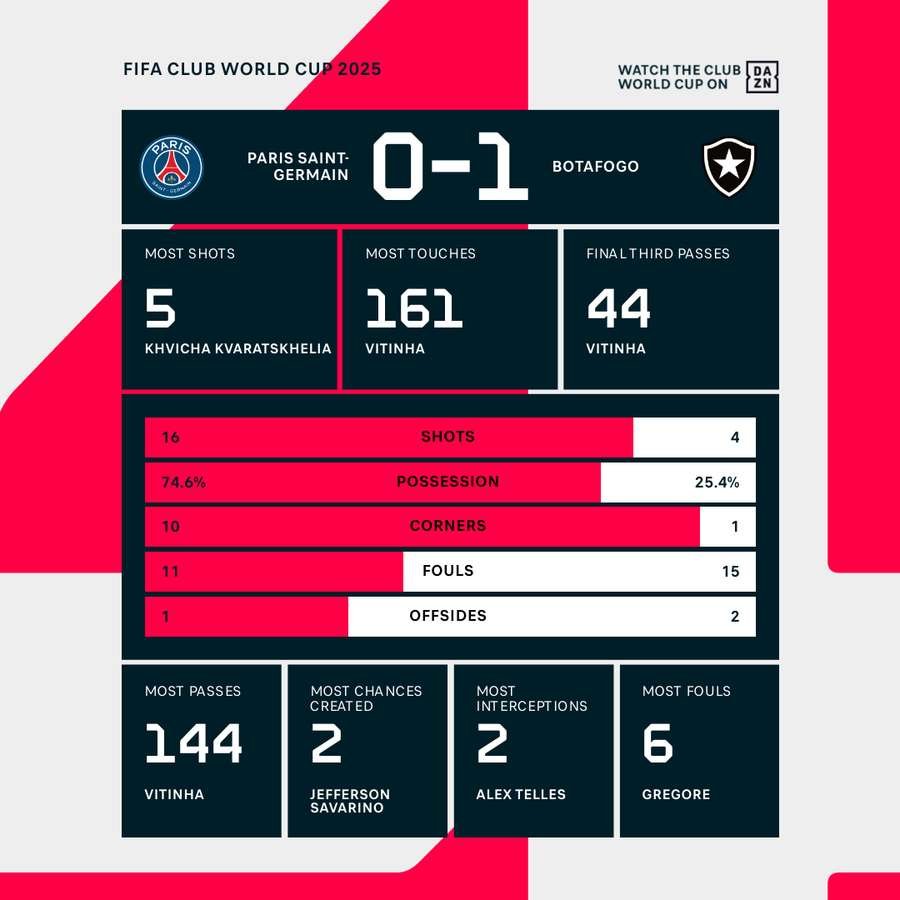
- Final Score: PSG 0 - 1 Botafogo
- Competition: FIFA Club World Cup Grp. B
- Date: Friday, June 20, 2025
- Venue: Rose Bowl, USA
- Goal Scorer: Jesus Savarino (Botafogo, 36')
- Significance: Botafogo secured a stunning upset victory over the heavily favored PSG.
The Unlikely Battle: Setting the Scene at the FIFA Club World Cup
The very idea of a "historical record" between PSG and Botafogo feels almost anachronistic, given their distinct continental domains. PSG, the reigning champions of French Ligue 1, have spent the last decade accumulating an arsenal of world-class talent, driven by Qatari investment and a relentless pursuit of European glory. Botafogo, on the other hand, represents the passion and flair of Brazilian football, a storied club from Rio de Janeiro with a rich past, but one that operates on a significantly different financial scale.
Their paths converged on June 20, 2025, at the iconic Rose Bowl in Pasadena, California, during the expanded FIFA Club World Cup. This tournament format, designed to pit the best clubs from across the globe against each other more frequently, finally provided the stage for this unprecedented clash. Pre-match predictions painted a clear picture: PSG were overwhelming favorites, with an estimated 77% chance of victory compared to Botafogo's modest 15%. A draw was considered an 8% long shot. The Parisian giants were expected to dominate, continuing their march through Group B.
However, football rarely adheres to scripts. The beauty of the sport lies in its capacity for the unexpected, and this particular encounter was destined to become a prime example. The stage was set for either a routine PSG win or a monumental upset—the latter proved to be the more thrilling outcome.
Matchday Breakdown: A Minute-by-Minute Account of Botafogo's Triumph
From the moment referee Drew Fischer blew his whistle to signal the start of the game, an undercurrent of tension was palpable. PSG, deploying a familiar 4-3-3 formation, featured a star-studded lineup including Donnarumma in goal, Hakimi, Beraldo, Pacho, and Lucas across the defense, Vitinha, Mayulu, and Zaire-Emery in midfield, and a formidable attacking trio of Kvaratskhelia, G. Ramos, and Doué. This was a team built to control games and score goals.
Botafogo, mirroring PSG’s 4-3-3, presented a squad characterized by grit and strategic discipline. John guarded the net, supported by defenders Telles, Barboza, Jair, and Vitinho. The midfield engine room consisted of Marlon, Gregore, and Allan, tasked with disrupting PSG's flow. Upfront, the attacking impetus came from Savarino, I. Jesus, and Artur.
The game largely unfolded as many expected in terms of possession. PSG asserted their dominance on the ball, meticulously building attacks, probing Botafogo's defensive lines. Yet, for all their possession, the breakthroughs weren't coming easily. Botafogo, organized and resolute, absorbed the pressure, showing remarkable tactical discipline.
Then, in the 36th minute, came the moment that etched this match into history. Against the run of play, Botafogo found their opening. A swift, incisive counter-attack, executed with precision, saw Jesus Savarino break free and calmly slot the ball past Donnarumma. The Rose Bowl erupted, a mixture of shock from PSG fans and utter elation from Botafogo supporters. The score: PSG 0 - 1 Botafogo. It was a lead they would take into halftime, a lead that suddenly made the impossible seem plausible.
The second half saw PSG intensify their efforts to find an equalizer. Coach Luis Enrique made swift tactical adjustments, introducing fresh legs to inject more dynamism. In the 55th minute, Ruiz Mayulu and Barcola came on for Mendes Hernández and Ramos, respectively. Moments later, Neves replaced Zaire-Emery, signaling a clear intent to increase offensive pressure.
Botafogo responded with their own strategic substitutions, aiming to maintain their defensive shape and fresh energy. Gregore came in at 57', followed by Rodríguez and Cuiabano for Savarino (the goal scorer) and Telles at 68'. Montoro replaced Artur at 77', and later Newton came on for Allan at 87'. These changes indicated a clear strategy: defend the lead, disrupt PSG's rhythm, and run down the clock.
Despite PSG's continued dominance in possession and shot attempts, Botafogo's defensive resolve held firm. They weathered the storm, repelling wave after wave of Parisian attacks. The final whistle brought not just an end to 90 minutes, but a seismic shock in the FIFA Club World Cup, confirming Botafogo's stunning 1-0 victory.
Beyond the Scoreline: Dissecting the Statistics
While the final score tells one story, the underlying statistics paint a more complex, and often contradictory, picture. This clash perfectly illustrates why football isn't merely a game of numbers, but of moments, efficiency, and sheer willpower.
| Statistic | PSG | Botafogo |
|---|---|---|
| Total Shots | 16 | 4 |
| Shots on Target | 2 | 4 |
| Possession | 75% | 25% |
| Attacks | 130 | 50 |
| Upon first glance, these numbers scream "PSG dominance." With 75% possession and a massive 130 attacks compared to Botafogo's 50, PSG controlled the flow of the game unequivocally. They also fired off 16 total shots, four times more than Botafogo's 4. | ||
| However, the crucial statistic lies in "Shots on Target." Here, Botafogo turned the tables, matching PSG's 4 shots on target despite having significantly fewer attempts overall. This highlights Botafogo's exceptional efficiency. Every one of their shots was a genuine threat, leading to their single, decisive goal. PSG, by contrast, struggled to turn their high volume of attempts into concrete danger, with only 2 of their 16 shots testing the goalkeeper. This clinical edge, or lack thereof, proved to be the defining factor. | ||
| Both teams started with a 4-3-3 formation, suggesting an intent to play attacking football. PSG's lineup, featuring stars like Donnarumma, Hakimi, Vitinha, Kvaratskhelia, and Ramos, was designed for high-octane offensive play. Botafogo, while also in a 4-3-3, played a more pragmatic version, using their wide players and central midfielders to press and transition quickly, aiming to exploit any defensive lapses from PSG's aggressive setup. This tactical battle ultimately favored Botafogo's more disciplined and opportunistic approach. |
Shockwaves and Standings: The Immediate Aftermath
The result sent shockwaves across the football world. A team with PSG's resources and reputation was expected to brush aside opponents, particularly in group stage encounters. This defeat was not just a loss of three points; it was a significant dent in their formidable image.
Despite the loss, PSG still held the top spot in FIFA Club World Cup Grp. B, albeit by a narrow margin. With 6 points from 3 games and a +5 goal difference, they led the group. Botafogo, also on 6 points from 3 games, moved into second place with a +1 goal difference. The victory propelled Botafogo into a strong position for qualification, proving that their pre-tournament status as underdogs was perhaps a misjudgment. The entire dynamic of the group changed, suddenly making the race for qualification far more compelling. This single match had a profound effect on PSG vs Botafogo standings within the group, turning a potential cakewalk for PSG into a genuine contest.
The pre-match predictions, which had given Botafogo only a 15% chance of winning, were utterly dismantled. This is the beauty and brutality of football—no odds, no statistical model, can fully account for the human element, the tactical masterclass, or the sheer luck that can swing a game. Botafogo's triumph became an instant classic, a reminder that the heart and strategy of the underdog can indeed prevail against overwhelming financial and talent disparities.
The Weight of Expectations: Why PSG Stumbled
Analyzing PSG's performance reveals a blend of misfortune and tactical missteps. Their overwhelming possession (75%) suggests they controlled the game, but it was largely sterile. They moved the ball, but often lacked the incisive pass, the killer instinct in the final third. The 16 total shots, yet only 2 on target, is a stark indicator of their profligacy. High-profile players, accustomed to dominating, found themselves frustrated by Botafogo's resilient low block and quick defensive transitions.
The substitutions made by PSG in the second half—Mayulu, Barcola, and Neves—were designed to add impetus, but they couldn't break the deadlock. Whether it was a lack of chemistry, an off-day for key players, or simply Botafogo’s impenetrable defense, PSG failed to convert their territorial advantage into goals. The immense pressure to perform on such a global stage, coupled with their status as heavy favorites, might have also contributed to a certain rigidity when faced with unexpected resistance.
Botafogo, on the other hand, executed a near-perfect game plan. They understood PSG's strengths and weaknesses. They conceded possession, knowing they couldn't compete toe-to-toe in a free-flowing exchange. Instead, they focused on defensive organization, disciplined pressing, and quick counter-attacks. Their goal, scored by Savarino, was a textbook example of capitalizing on minimal opportunities. Goalkeeper John and the entire defensive unit were phenomenal, making crucial blocks and clearances, and ensuring that PSG's few shots on target were either saved or fluffed. Their substitutions, bringing in fresh legs in midfield and defense, were timed perfectly to maintain their shape and energy levels against a relentless PSG attack.
Fan Reactions and Media Buzz: A Global Conversation
The aftermath of this singular clash generated significant buzz across social media and traditional sports media outlets worldwide. For Botafogo fans, it was a moment of immense pride and celebration. Beating a club of PSG's stature, with their galaxy of stars, in such a high-profile tournament, was a statement victory. It reignited discussions about the enduring quality of Brazilian football and the potential for "underdog" teams to upset the established European order. It demonstrated Botafogo's resurgence as a force to be reckoned with.
For PSG and their supporters, the reaction was one of disappointment and introspection. While not a catastrophic result in terms of qualification, the manner of the defeat and the perceived gulf in quality on paper sparked debates about the team's mental fortitude, their reliance on individual brilliance, and their ability to break down well-organized defensive units. The global football community, always keen for a David vs. Goliath narrative, reveled in the upset, hailing Botafogo's strategic brilliance and resilience. This match quickly became a talking point, underscoring the magic of the FIFA Club World Cup to deliver compelling, unexpected stories.
Looking Ahead: What This Single Encounter Teaches Us
While the "Historial de Enfrentamientos Directos PSG vs Botafogo" currently boasts only one entry, this game provides invaluable lessons for both clubs and for football enthusiasts.
For PSG, it served as a stark reminder that talent alone is insufficient. Tactical discipline, clinical finishing, and the ability to adapt against unexpected resistance are paramount. The defeat will undoubtedly fuel deeper analysis of their squad depth, their tactical flexibility, and their psychological preparedness for global tournaments. It highlights the importance of not underestimating any opponent, regardless of their perceived status.
For Botafogo, the victory is a huge confidence booster and a validation of their project. It demonstrates that with a clear strategy, collective effort, and unwavering belief, they can compete with the very best. This win will undoubtedly raise their international profile, attract new talent, and inspire their fanbase. It’s a testament to the power of teamwork and strategic execution over individual star power.
For the FIFA Club World Cup itself, this match underscored the thrilling potential of the expanded format. It delivered exactly the kind of cross-continental drama and upset that makes international club competitions so compelling. It reinforced the idea that football is truly global, and talent and tactical acumen can emerge from any corner of the world.
The Enduring Legacy of a Singular Confrontation
The "Historial de Enfrentamientos Directos PSG vs Botafogo" is short, but its single entry is rich with narrative. It���s a story of one goal, one tactical masterclass, and one memorable upset that defied the odds. While future clashes between these two clubs are not guaranteed, this first encounter has set a captivating precedent. Should their paths cross again in a future tournament, the memory of that Friday in June 2025 at the Rose Bowl will undoubtedly loom large.
It reminds us all that in football, history isn't just made over decades; sometimes, a single game can encapsulate all the drama, passion, and unpredictability that makes the sport the world's most beloved. Botafogo’s 1-0 victory over PSG stands as a powerful testament to the enduring spirit of competition and the beautiful possibility of the underdog triumphing against the giants. It's a chapter, singular yet significant, in the ongoing saga of global football.